 By Saurav Mehra
 India crossed 58.14 GW of installed wind capacity by July 2026, with another 28 GW currently under implementation, and government targets now point toward 100 GW by 2030. This list of the top 10 wind turbine manufacturers in India 2026 covers the companies actually building that infrastructure — a genuinely competitive mix of domestic pioneers, Chinese challengers gaining ground, and European giants navigating a market that’s rewarding local manufacturing over imported scale.
What’s particularly notable this year is how domestic manufacturers have clawed back market share, with Indian OEMs accounting for roughly 49% of annual installations in FY2026, up from just 31% two years earlier. Here’s a breakdown of who’s actually winning orders and building turbines across India’s wind corridors.
| Company | Origin | Known For | 2026 Position |
| Suzlon Energy | India (Pune) | S-series turbines, low/medium wind speeds | Market leader, 6.1 GW order book |
| Inox Wind | India (Chennai/Noida) | 3 MW and 3.3 MW platforms | Tier-one domestic OEM |
| Siemens Gamesa (TPG-led) | Spain (India ops) | SG 3.4-145 platform, blades and nacelles | Restructured under TPG ownership |
| Vestas India | Denmark (India ops) | Global technology, localized manufacturing | Steady technology footprint |
| GE Vernova (GE Renewable Energy) | USA (India ops) | Digital integration, large-diameter rotors | Scaling up presence |
| Envision Energy | China (Shanghai) | One of world’s largest turbine makers | Significant FY26 installation share |
| SANY Renewable Energy | China | 4 MW turbine, 168m rotor | Growing India deployment |
| Adani Wind | India | Scaling manufacturing capacity | Expanding domestic player |
| Wind World India (Enercon) | India (Mumbai) | Established since 1994 | Legacy domestic manufacturer |
| ReNew Power | India | Advanced wind resource simulation | Leading IPP/developer |
1. Suzlon Energy
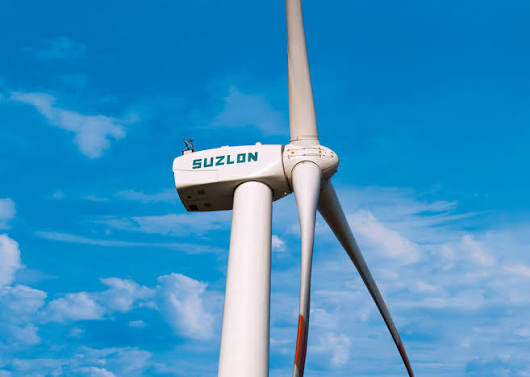
Suzlon dominates India’s wind turbine market without much competition for the top position, and its recent delivery numbers reflect genuine operational recovery after years of financial struggle.
- Founded in 1995 by the late Tulsi Tanti, headquartered in Pune
- Holds a dominant market position with an installed capacity of roughly 14.8 GW in India, out of 20.8 GW globally
- Delivered a record 2,456 MW in FY2026, up sharply from 1,550 MW in FY2025
- Currently holds a 6.1 GW order book, the strongest of any wind OEM operating in India
- S-series turbines are specifically engineered for the low and medium wind speed conditions common across Indian onshore terrain
2. Inox Wind
Inox Wind has firmly established itself as one of India’s tier-one wind manufacturers, backed by a growing order book concentrated in western state pipelines.
- Market capitalisation of roughly ₹305.17 billion, reflecting genuine investor confidence
- Flagship 3 MW platform with booster capacity up to 3.3 MW, listed on MNRE’s Revised List of Models and Manufacturers
- Secured a major 153 MW order in March 2025, alongside a 200 MW order across Gujarat and Rajasthan in mid-2024
- Order book concentrated heavily in Gujarat-led buildouts and broader western state wind corridors
3. Siemens Gamesa (TPG-led Entity)
Siemens Gamesa’s Indian operations underwent one of the sector’s most significant restructurings in recent memory, now operating under new private equity ownership.
- Officially acquired by global investment firm TPG in March 2025
- Has operated in India since 2009, among the country’s earliest major contributors to installed wind capacity
- Indian manufacturing covers both blades and nacelles domestically
- SG 3.4-145 platform, with a rotor diameter of roughly 145 metres, targets low- and medium-wind locations effectively
4. Vestas India
Vestas brings genuine global technology depth into the Indian market, having localized its manufacturing specifically to suit Indian operating conditions.
- Global leader in wind turbine technology with dedicated Indian manufacturing and servicing capabilities
- Maintains significant technology and servicing footprint despite less visible order momentum compared to domestic players recently
- Remains important for its extensive global technology portfolio and proven international track record
- Positioned toward developers prioritizing established global engineering standards over purely domestic sourcing
5. GE Vernova (GE Renewable Energy)
GE Vernova specializes in digital integration and turbine designs specifically engineered for challenging low-wind site conditions.
- Focus on large-diameter rotors optimized for locations with weaker average wind resources
- Digital integration capabilities support better performance monitoring and predictive maintenance
- Continues scaling its Indian presence alongside the broader domestic manufacturing expansion
- Backed by GE’s global renewable energy engineering resources and technology development
6. Envision Energy
Envision has built a genuinely significant presence in India as part of its broader global operations, ranking among the world’s largest wind turbine manufacturers.
- Headquartered in Shanghai, China, also providing energy management software alongside turbine manufacturing
- Contributed meaningfully to the roughly 33% of FY2026 Indian installations attributed to Chinese OEMs collectively
- Combines energy technology services with core turbine manufacturing, differentiating it from pure hardware suppliers
- Growing presence reflects the broader shift of Chinese manufacturers gaining traction in India’s wind market
7. SANY Renewable Energy
SANY has entered India’s wind sector with genuinely large-scale turbine technology, deploying projects that showcase its engineering capabilities.
- Deploying a 4 MW turbine featuring a 168-metre rotor diameter
- Notable project includes a 52 MW Sembcorp development in Karnataka using 13 turbines of 4 MW each
- Represents the growing wave of Chinese manufacturers competing directly with established European and domestic players
- Part of the broader trend of manufacturers offering larger rotor diameters to improve energy capture at lower wind speeds
8. Adani Wind
Adani Wind has been scaling its manufacturing capacity as part of the broader Adani Group’s push into renewable energy infrastructure.
- Actively expanding domestic manufacturing capacity alongside other growing Indian players
- Benefits from the Adani Group’s broader infrastructure, logistics, and industrial capabilities
- Represents a newer but genuinely significant domestic entrant into India’s competitive wind manufacturing landscape
- Positioned to benefit from India’s push toward greater domestic wind turbine indigenization
9. Wind World India (Enercon India)
Wind World India brings genuine longevity to this list, having operated in India’s wind sector since 1994, predating much of the current competitive landscape.
- Based in Mumbai, with roughly 5,000 employees supporting its operations
- Long-established domestic manufacturing history gives it deep familiarity with Indian wind conditions
- Represents the earlier generation of Indian wind manufacturers that helped establish the domestic industry
- Continues operating within India’s broader turbine manufacturing ecosystem alongside newer entrants
10. ReNew Power
ReNew Power occupies a slightly different role than pure turbine manufacturers — it’s one of India’s leading renewable energy developers with deep wind resource expertise.
- Established in 2011, focused specifically on renewable energy development including significant wind capacity
- Recognized for sophisticated software simulations used to identify and optimize wind resource sites
- Active in key wind corridors including Gujarat and Rajasthan
- Represents the developer side of India’s wind ecosystem, working closely with turbine manufacturers to deploy utility-scale projects
Understanding India’s Wind Turbine Manufacturing Landscape
A few practical points help make sense of where this sector stands and how the market actually works:
- Domestic manufacturers are gaining ground on Chinese and European rivals — Indian OEMs led by Suzlon and Inox Wind captured roughly 49% of FY2026 installations, up meaningfully from just 31% in FY2024
- India has achieved 70-80% indigenisation across major turbine components — including blades, towers, and gearboxes, strengthening the country’s position as both a wind market and a manufacturing hub
- Domestic manufacturing capacity has expanded dramatically — from roughly 10 GW annually in 2014 to around 24 GW today, creating genuine growth opportunity for established players
- MNRE’s Revised List of Models and Manufacturers (RLMM) matters for project approval — turbine models need this listing to qualify for many government-backed and utility-scale wind projects
- Localization increasingly beats global scale for winning orders — competitive pricing, manufacturing availability, and faster supply-chain response are becoming decisive advantages over purely international brand recognition
FAQs
Q1. Which wind turbine manufacturer is best suited for low-wind-speed sites common in India?
Suzlon’s S-series turbines are specifically engineered for low and medium wind speed conditions, making them a strong fit for much of India’s onshore terrain. Manufacturers like GE Vernova and SANY, with their larger-diameter rotors, also target this same challenge through improved energy capture at lower wind speeds.
Q2. Why did Siemens Gamesa’s Indian operations get acquired by TPG rather than continuing under Siemens ownership?
The March 2025 acquisition by TPG, a global investment firm, reflected a broader restructuring within the Indian wind sector rather than a decline in Siemens Gamesa’s technical capabilities. The entity continues operating with its established manufacturing footprint and SG 3.4-145 platform under the new ownership structure.
Q3. Does India currently have offshore wind projects, or is the market entirely onshore?
India’s wind sector remains predominantly onshore, with the vast majority of the country’s 58.14 GW installed capacity coming from onshore projects across states like Gujarat, Tamil Nadu, and Rajasthan. Offshore wind remains in earlier development stages compared to onshore, though it’s expected to grow as part of longer-term capacity targets toward 2030 and beyond.
Q4. How does a turbine’s RLMM listing affect whether a wind developer can use it for a project?
Many government-backed and utility-scale wind projects require turbine models to appear on MNRE’s Revised List of Models and Manufacturers before approval. This listing process verifies technical compliance and performance standards, making it a genuine gatekeeping factor for manufacturers wanting access to India’s larger institutional wind project pipeline.