 By Chetan Singh
 For millions of 10th-pass candidates across India seeking stable central government employment, the SSC MTS (Multi-Tasking Staff) examination is one of the most accessible and popular options. The role offers something rare in the entry-level job market — permanent government employment, annual increments, a defined pension scheme, medical benefits, and a structured career path, all available to candidates who have cleared Class 10. The salary may be modest in absolute terms, but the long-term financial security attached to the package is genuinely significant.
This article covers the complete SSC MTS salary structure for 2026 — basic pay, all allowances, city-wise in-hand figures, deductions, and how the salary grows over years of service.
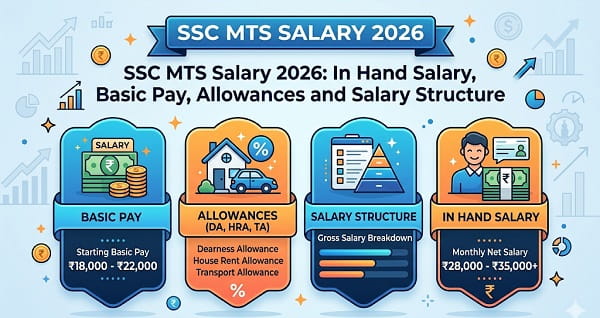
SSC MTS Salary 2026: Quick Overview
| Component | Details |
| Pay Level | Level 1 (7th Pay Commission) |
| Starting Basic Pay | ₹18,000 per month |
| Grade Pay | ₹1,800 |
| Gross Salary Range | ₹20,000 – ₹28,500 (city-dependent) |
| In-Hand Salary Range | ₹18,000 – ₹26,000 (city-dependent) |
| Maximum Basic Pay | ₹56,900 (after 20+ years) |
| Annual Increment | 3% of basic pay |
The in-hand salary varies meaningfully based on the city of posting — officers in X-category metro cities receive significantly higher HRA and TA than those in Y or Z-category cities.
SSC MTS Pay Scale 2026
Under the 7th Pay Commission, SSC MTS falls under Pay Level 1 of the pay matrix:
Basic Pay Range: ₹18,000 – ₹56,900
Annual increment: 3 percent of basic pay every year, compounding over the course of the career. The maximum basic pay of ₹56,900 is reached after approximately 20 or more years of service, by which time DA and allowances would substantially increase total monthly earnings beyond this base figure.
SSC MTS Salary Structure: All Components
Basic Pay
₹18,000 per month uniformly across all postings. This is the foundation — all percentage-based allowances are calculated on this base.
Dearness Allowance (DA)
Revised twice yearly — in January and July — based on the All India Consumer Price Index. Currently at approximately 50 percent of basic pay. For an SSC MTS employee, DA adds approximately ₹9,000 per month and grows automatically with every CPI revision, meaning real salary increases occur even without promotions or increments.
House Rent Allowance (HRA)
The most location-sensitive component. HRA varies by the city category of the posting:
| City Category | Examples | HRA Rate | HRA Amount |
| X (Metro) | Delhi, Mumbai, Chennai, Kolkata, Bengaluru, Hyderabad | 27% of Basic | ₹4,860 |
| Y (Large Cities) | Lucknow, Jaipur, Chandigarh, Bhopal, Patna | 18% of Basic | ₹3,240 |
| Z (Other Cities) | Smaller towns and rural areas | 9% of Basic | ₹1,620 |
Employees allotted government quarters receive nominal HRA rather than full cash HRA.
Transport Allowance (TA)
A fixed monthly component to cover commuting costs. For Level 1 employees:
- X-category cities: ₹1,350 per month
- Y and Z-category cities: ₹900 per month
DA is also paid on TA in some categories, adding a small additional amount.
Night Duty Allowance / Special Allowance
Certain MTS postings — particularly Havaldar posts in CBIC (Central Board of Indirect Taxes and Customs) — attract additional allowances for duty at odd hours or in physically demanding conditions.
City-Wise SSC MTS Gross and In-Hand Salary 2026
| City Type | Basic Pay | DA (50%) | HRA | TA | Gross | Deductions | In-Hand |
| X (Metro) | ₹18,000 | ₹9,000 | ₹4,860 | ₹1,350 | ₹33,210 | ₹5,000–7,000 | ₹26,000–₹28,000 |
| Y (Large) | ₹18,000 | ₹9,000 | ₹3,240 | ₹900 | ₹31,140 | ₹5,000–6,500 | ₹24,500–₹26,000 |
| Z (Other) | ₹18,000 | ₹9,000 | ₹1,620 | ₹900 | ₹29,520 | ₹4,500–6,000 | ₹23,500–₹25,000 |
Note: Different sources report varying in-hand figures depending on which specific deductions they include and the DA rate applied at time of calculation. The figures above incorporate current DA of approximately 50 percent and standard deductions.
Deductions from SSC MTS Salary
| Deduction | Amount (Approx.) |
| NPS Contribution (10% of basic) | ₹1,800 |
| CGHS Contribution | ₹250 |
| Group Insurance | ₹30 – ₹100 |
| Income Tax | Nil for most (below taxable threshold) |
| Other Minor Deductions | ₹200 – ₹500 |
| Total Deductions | ₹2,280 – ₹2,650 |
Most SSC MTS employees fall below the income tax threshold under the new tax regime, meaning income tax deduction is typically zero or minimal at entry level. This keeps in-hand salary closer to gross compared to higher-paying government roles.
SSC MTS vs SSC Havaldar: Salary Comparison
The SSC MTS recruitment includes two post types — Multi-Tasking Staff (MTS) and Havaldar (in CBIC and CBN). Both sit at Pay Level 1 with the same basic pay of ₹18,000. The difference lies in job profile, uniform, and some posting-specific allowances.
| Feature | MTS | Havaldar |
| Basic Pay | ₹18,000 | ₹18,000 |
| Pay Level | Level 1 | Level 1 |
| Uniform | Yes | Yes |
| Physical Requirements | Lower | Higher |
| Night Duty | Occasional | Frequent |
| Night Duty Allowance | Limited | More applicable |
Additional Benefits Beyond Monthly Salary
National Pension System (NPS) — Both employee (10 percent of basic) and government (14 percent of basic) contribute to a retirement corpus each month. The total monthly NPS contribution is ₹4,320 — building a substantial post-retirement fund without any additional effort from the employee.
Central Government Health Scheme (CGHS) — Comprehensive medical care for the employee and dependents at CGHS dispensaries, empanelled hospitals, and government medical facilities. The CGHS contribution of ₹250 per month is remarkably low for the coverage provided.
Leave Entitlement — 30 days earned leave, 8 days casual leave, and medical leave annually.
Leave Encashment — Unused earned leave can be encashed at retirement — a meaningful lump-sum benefit after decades of service.
Pension on Retirement — Under NPS, the accumulated corpus (both employee and government contributions plus market returns) converts into a monthly pension at retirement.
Annual Increment — A guaranteed 3 percent increase in basic pay every year, regardless of promotion status. This compounds meaningfully over a 20 to 25 year career — a ₹18,000 basic at joining grows to approximately ₹30,000+ in basic pay after 20 years through increments alone.
SSC MTS Salary After 5, 10 and 20 Years
| Years of Service | Basic Pay (Approx.) | Estimated Monthly In-Hand |
| At Joining | ₹18,000 | ₹23,500 – ₹28,000 |
| After 5 years | ₹20,880 | ₹26,000 – ₹31,000 |
| After 10 years | ₹24,210 | ₹29,000 – ₹35,000 |
| After 20 years | ₹32,500 (approx.) | ₹40,000 – ₹48,000+ |
As basic pay rises, DA and HRA rise proportionally, making total earnings growth faster than the increment figure alone suggests. DA revisions every 6 months add to this without requiring any promotion.
Career Growth and Promotion Path
SSC MTS employees have a defined promotion ladder within central government departments:
| Stage | Role | Approximate Timeline |
| Multi-Tasking Staff (MTS) | Entry-level | At joining |
| Lower Division Clerk (LDC) | Promoted via departmental exam | After 5–8 years |
| Upper Division Clerk (UDC) | Promoted via departmental exam | After 12–15 years |
| Assistant Section Officer (ASO) | Performance and seniority | Senior stage |
| Section Officer (SO) | Merit and tenure | Late career |
Each promotion brings a shift to a higher pay level — LDC sits at Level 2, UDC at Level 4, and ASO at Level 6 — with significantly higher basic pay, allowances, and career status at each stage.
8th Pay Commission: Expected Impact
The 8th Pay Commission, constituted in January 2025, is expected to revise central government pay structures. For Level 1 employees like SSC MTS, the anticipated fitment factor of approximately 2.28 could raise basic pay from ₹18,000 to approximately ₹40,000 to ₹46,000 — nearly doubling the entry-level salary. Until official implementation and notification, current 7th CPC rates remain in effect with revised pay expected as arrears from the effective date.
SSC MTS Job Profile: What the Work Involves
SSC MTS employees are placed in Group C non-gazetted, non-ministerial posts across central government ministries and departments. Core duties include:
- Movement of files and papers within and outside the office premises
- Physical maintenance of office records and registers
- Photocopying, fax, and basic document dispatch
- Assisting in routine office work — diary, dispatch, computer assistance
- Delivery of postal and official correspondence outside the building
- Watch and ward duties in certain deployments
- Cleaning and maintenance of the office environment
The work is non-technical, non-supervisory, and widely distributed across departments including Income Tax, Postal, Defence, Railways (civilian), and various central ministries.
Conclusion
SSC MTS salary in 2026, while modest in absolute terms at ₹18,000 basic and ₹23,500 to ₹28,000 in-hand monthly, comes attached to a package of long-term financial security that genuinely sets it apart from comparable private sector entry-level roles. NPS pension contributions, free CGHS medical coverage for the entire family, 30 days earned leave with encashment benefits, guaranteed 3 percent annual increments, and a structured promotion ladder make this one of the most stable career choices available after Class 10 in India. With the 8th Pay Commission expected to significantly revise Level 1 basic pay, candidates joining in 2026 stand to benefit from a meaningful salary hike within their early years of service.
FAQs
Q: What is the SSC MTS in-hand salary per month in 2026?
A: After all deductions, the in-hand salary ranges from approximately ₹23,500 to ₹28,000 per month depending on the city of posting. Metro (X-category) postings receive the highest in-hand salary due to elevated HRA.
Q: What is the starting basic pay for SSC MTS in 2026?
A: The starting basic pay is ₹18,000 per month at Pay Level 1 of the 7th Central Pay Commission pay matrix.
Q: Do SSC MTS employees get pension?
A: Yes. Employees are covered under the National Pension System (NPS). Both the employee (10 percent) and the government (14 percent) contribute monthly, building a retirement corpus that converts into a monthly pension at superannuation.
Q: What is the difference between SSC MTS and Havaldar salary?
A: Both posts have identical basic pay of ₹18,000 at Pay Level 1. The Havaldar post in CBIC may attract additional night duty and field-related allowances. The main differences lie in job profile and physical requirements, not basic pay.
Q: Can an SSC MTS employee get promoted to a higher post?
A: Yes. Through departmental examinations, MTS employees can be promoted to Lower Division Clerk (LDC), Upper Division Clerk (UDC), and further up to Assistant Section Officer level over the course of their career.
 Saurav Mehra