 By Chetan Singh
 One of the most searched and genuinely surprising facts in Indian public life is how little the Prime Minister of India officially earns. The head of the world’s most populous democracy, commanding the largest bureaucracy in the world, navigating foreign policy, managing the economy, and governing 1.4 billion people — draws a monthly salary that a mid-level private sector manager in Mumbai would comfortably exceed. The numbers are not a secret. They are set by Parliament under a specific law and available in public records. What they reveal about the design of Indian constitutional democracy is worth understanding fully.
This article provides the complete Prime Minister of India salary structure for 2026 — basic pay, every allowance, in-hand take-home, post-retirement benefits, and how the total compensation package compares with other top constitutional posts.
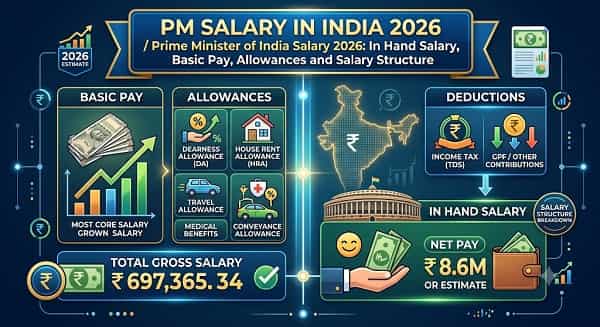
Prime Minister of India Salary: Quick Overview
| Component | Monthly Amount |
| Basic Pay | ₹50,000 |
| Sumptuary Allowance | ₹3,000 |
| Daily Allowance | ₹2,000 per day (approximately ₹62,000 per month) |
| Parliamentary Constituency Allowance | ₹45,000 |
| Total Official Monthly Salary | Approximately ₹1,60,000 – ₹1,66,000 |
| Annual Gross Salary | ₹19.20 – ₹19.92 Lakh |
| Estimated In-Hand (After Deductions) | ₹1,10,000 – ₹1,30,000 per month |
Legal Framework: Who Decides the PM’s Salary?
The Prime Minister’s salary is not determined by the Cabinet or the PM’s office. It is governed by two specific pieces of legislation:
The Salaries and Allowances of Ministers Act, 1952 — Sets the basic pay, sumptuary allowance, and expense-related components for all Union Ministers including the Prime Minister.
The Salaries, Allowances and Pension of Members of Parliament Act, 1954 — Since the Prime Minister is also a Member of Parliament (MP), this Act governs the parliamentary allowances — constituency allowance and daily allowance during sessions.
The salary is drawn from the Consolidated Fund of India, managed by the Ministry of Finance. Any revision requires a parliamentary vote — the PM cannot revise their own salary.
Complete Salary Structure: Component by Component
Basic Pay — ₹50,000 Per Month
The foundation of the Prime Minister’s official salary. This figure has remained unchanged for a considerable period. For context: a freshly recruited IAS officer draws a basic pay of ₹56,100 — slightly more than the Prime Minister’s basic pay. A Cabinet Secretary draws ₹2,50,000. The Prime Minister’s basic pay is modest by design.
Sumptuary Allowance — ₹3,000 Per Month
A small fixed allowance covering certain personal and representational expenses. This amount is the same for all Union Cabinet Ministers and has not been revised significantly in recent years.
Daily Allowance — ₹2,000 Per Day
This is the most significant variable component. The daily allowance is paid for every day Parliament is in session and for official engagements. When calculated across a full month of active duty (approximately 30 days), this amounts to roughly ₹60,000 to ₹62,000 per month. The daily allowance reflects the assumption that the PM is always engaged in official capacity.
Parliamentary Constituency Allowance — ₹45,000 Per Month
As a sitting Member of Parliament — the PM represents Varanasi in the current arrangement — the Prime Minister draws the standard MP constituency allowance of ₹45,000 per month. This is identical to what every other MP receives and is intended to cover constituency-related expenses.
Office Expense Allowance — ₹25,000 Per Month (Office) + ₹50,000 (Secretarial)
MPs, including the PM, are entitled to office expense reimbursement of ₹25,000 for office expenses and ₹50,000 for secretarial assistance monthly. However, in practice, the Prime Minister’s official secretariat is separately supported by the PMO budget and government infrastructure.
PM Salary 2026: Detailed Monthly Breakdown
| Component | Amount Per Month |
| Basic Pay | ₹50,000 |
| Sumptuary Allowance | ₹3,000 |
| Daily Allowance (~31 days) | ₹62,000 |
| Constituency Allowance (MP) | ₹45,000 |
| Gross Monthly Salary | ₹1,60,000 – ₹1,66,000 |
Deductions and In-Hand Salary
The Prime Minister pays income tax on the official salary like any salaried individual. A mandatory contribution equivalent to 30 percent of basic pay goes toward provident fund, pension, and group insurance.
| Deduction | Approx. Amount |
| Income Tax | ₹20,000 – ₹35,000 |
| PF / Pension contribution (30% of basic) | ₹15,000 |
| Other statutory deductions | ₹2,000 – ₹5,000 |
| Estimated In-Hand Monthly | ₹1,10,000 – ₹1,30,000 |
The annual gross salary amounts to approximately ₹19.20 to ₹19.92 lakh. After taxes and deductions, the annual in-hand figure comes to roughly ₹13.20 lakh to ₹15.60 lakh — which, for an individual of this responsibility and position, is one of the most restrained executive compensation structures among major democracies worldwide.
Non-Monetary Benefits and Perks: The Real Package
While the cash salary is modest, the operational support provided to the Prime Minister is comprehensive and befitting the head of government. These are government facilities — not personal income — but they meaningfully define the PM’s working life.
Official Residence — 7, Lok Kalyan Marg, New Delhi
The Prime Minister’s official bungalow on one of Delhi’s most prestigious addresses. The residence includes security quarters, office space, gardens, and a full complement of support staff. The government bears all maintenance, utilities, and staffing costs. The rental value in Lutyens’ Delhi, if commercially assessed, would run into several lakh rupees monthly.
Special Protection Group (SPG) Security
The Prime Minister receives SPG protection — the highest and most sophisticated personal security available in India. Coverage extends 24 hours a day, 365 days a year, including domestic and international travel. The operational cost of SPG deployment is a significant government expense entirely separate from the PM’s salary.
Air India One — Official Air Travel
The Prime Minister travels on Air India One — a modified Boeing 777 with advanced communications, medical equipment, and security features dedicated to the PM and the President. Domestic and international official travel is entirely covered by government.
Official Vehicle Fleet
A fleet of official cars with drivers and security escorts for all movement within and outside Delhi, maintained entirely by the government.
Medical Facilities
Comprehensive medical care at AIIMS and all Central Government Health Scheme (CGHS) facilities, with immediate access to the best medical infrastructure in the country.
Staff and Secretariat
A full PMO operational support structure including personal staff, press liaisons, and administrative officers. Post-retirement, the former PM is entitled to a secretarial staff of 14 members for a period of five years.
Telephone and Communication
All official communication costs — landlines, broadband, and mobile communications on official duty — are borne by the government.
Post-Retirement Benefits for the Prime Minister
After leaving office, a former Prime Minister of India receives:
| Benefit | Details |
| Monthly Pension | 50% of the last drawn basic pay — approximately ₹25,000 per month |
| Rent-Free Accommodation | Government bungalow for life (or as per relevant rules in force) |
| SPG Security | Extended for 5 years post-retirement |
| Medical Facilities | Lifetime free medical care at government hospitals |
| Secretarial Staff | 14 staff members for 5 years after retirement |
| Official Vehicle | Government car with driver during the post-retirement support period |
PM Salary Compared to Other Top Constitutional Posts in India
| Position | Monthly Salary (Approx.) |
| President of India | ₹5,00,000 |
| Vice President of India | ₹4,00,000 |
| Chief Justice of India | ₹2,80,000 |
| Governor of a State | ₹3,50,000 |
| Prime Minister of India | ₹1,60,000 – ₹1,66,000 |
| Cabinet Secretary (IAS) | ₹2,50,000 |
| Supreme Court Judge | ₹2,50,000 |
| Member of Parliament | ₹1,24,000 + allowances |
The Prime Minister’s official salary is lower than that of the President, Vice President, all State Governors, and the Chief Justice. It is broadly comparable to a Member of Parliament since the PM draws MP-level parliamentary allowances. The Cabinet Secretary — technically subordinate to the PM — draws a higher basic pay.
This design reflects a deliberate constitutional philosophy: the Prime Minister of India draws a representative salary that signals accountability to the public rather than executive compensation calibrated to responsibility.
How India’s PM Salary Compares Globally
For reference, the Prime Minister of India’s official annual salary of ₹19.20 lakh (approximately USD 22,000 at current exchange rates) is among the most modest for a head of government anywhere in the world. The US President earns USD 400,000 annually. The UK Prime Minister draws approximately £168,861. Singapore’s Prime Minister earns over SGD 2 million annually. Even accounting for purchasing power parity differences, the Indian PM’s cash salary is notably restrained — a fact that has remained consistent across administrations for decades.
Conclusion
The Prime Minister of India salary in 2026 stands at approximately ₹1,60,000 to ₹1,66,000 per month in gross terms, with an estimated in-hand take-home of ₹1,10,000 to ₹1,30,000 after income tax and statutory deductions. The annual gross salary of ₹19.20 to ₹19.92 lakh is one of the lowest among heads of government globally and lower than several senior constitutional officers within India itself. The true value of the PM’s compensation lies not in the monthly salary but in the comprehensive government infrastructure — residence at Lok Kalyan Marg, SPG security, Air India One travel, lifetime medical care, and a post-retirement support package — that enables the effective discharge of the world’s most demanding democratic executive responsibility.
FAQs
Q: What is the Prime Minister of India’s salary per month in 2026?
A: The PM’s official monthly salary is approximately ₹1,60,000 to ₹1,66,000, comprising basic pay of ₹50,000, sumptuary allowance of ₹3,000, daily allowance of approximately ₹62,000, and parliamentary constituency allowance of ₹45,000.
Q: What is the PM’s in-hand salary after deductions?
A: After income tax and statutory contributions including PF and group insurance, the estimated in-hand salary ranges from ₹1,10,000 to ₹1,30,000 per month.
Q: Who decides the Prime Minister’s salary in India?
A: The salary is governed by the Salaries and Allowances of Ministers Act, 1952 and the Salaries, Allowances and Pension of Members of Parliament Act, 1954. Any revision requires a vote of Parliament — the PM cannot unilaterally revise their own salary.
Q: Is the Prime Minister’s salary lower than other constitutional posts?
A: Yes. The President earns ₹5,00,000 per month, the Vice President ₹4,00,000, State Governors ₹3,50,000, and even the Cabinet Secretary draws a basic pay of ₹2,50,000 — all higher than the PM’s official salary. The PM’s compensation is deliberately modest.
Q: What does a former Prime Minister receive after retirement?
A: A former PM is entitled to a monthly pension of approximately 50% of last drawn basic pay, rent-free government accommodation, SPG security for five years, lifetime medical facilities, and a secretarial staff of 14 members for five years after leaving office.
 Saurav Mehra
I want work need job
I salary