 By Saurav Mehra
 How cryptocurrency swing trading works comes down to one core idea: instead of chasing every five-minute candle like a day trader, or holding for years like a long-term investor, you’re trying to catch the medium-sized waves in between — price moves that play out over several days to a few weeks. It sits in the middle ground between two exhausting extremes, which is exactly why it’s become one of the more practical approaches for people who want to actively trade without staring at charts all day.
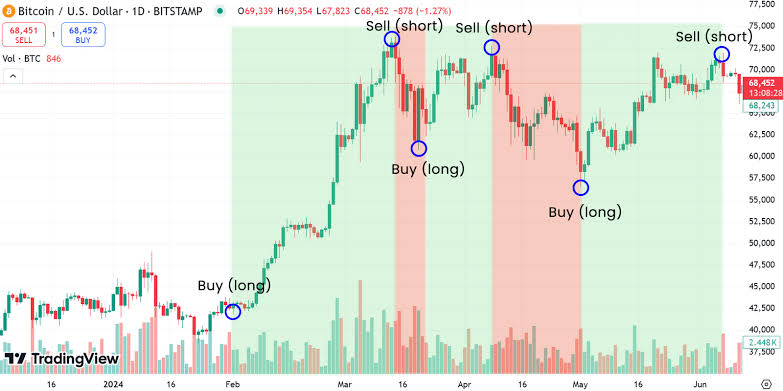
| Quick Facts | Details |
| Typical holding period | Several days to a few weeks |
| Core goal | Capture medium-term price swings, not intraday noise or years-long trends |
| Most common indicators | RSI, MACD, moving averages (50-day and 200-day EMA), volume |
| Standard risk-per-trade rule | 1-2% of total trading capital risked on any single trade |
| Minimum reward-to-risk ratio most traders target | 1:2 or better — risking ₹1 to potentially gain ₹2+ |
| Recommended starting approach | Demo or paper trading before committing real capital |
Here’s something that genuinely changes the calculation compared to stock swing trading: crypto markets never close. Traditional swing traders deal with a single “overnight gap” once a day, when the market reopens after being shut. Crypto has no closing bell at all — price can move sharply at 3 AM on a Sunday just as easily as during peak trading hours, and if you’re asleep or away from your screen, that move happens with nobody watching. The stop-loss orders swing traders rely on become genuinely essential here, not just a nice-to-have, precisely because there’s no scheduled pause where you can catch your breath and reassess.
What Swing Trading Actually Means
Placing it clearly against the two strategies people most often confuse it with:
- Day trading closes every position within the same day, sometimes within minutes, chasing small intraday moves repeatedly
- Swing trading holds positions for days to weeks, aiming to capture a single larger price move rather than dozens of small ones
- HODLing (long-term holding) ignores short-term price action almost entirely, holding for months or years regardless of swings
- Swing trading requires less screen time than day trading but more active decision-making than simply holding
- It works by combining technical analysis — chart patterns and indicators — with a defined entry point, exit target, and stop-loss before the trade is even opened
The Core Indicators Swing Traders Rely On
A focused toolkit tends to work better than stacking every indicator available onto one chart.
- Moving averages (commonly the 50-day and 200-day EMA) — identify the broader trend direction
- RSI (Relative Strength Index) — flags whether an asset looks overbought or oversold, hinting at potential reversal points
- MACD (Moving Average Convergence Divergence) — helps confirm momentum shifts and trend changes
- Fibonacci retracement levels — used to identify likely pullback zones within a broader trend, with the area between 0.618 and 0.66 often called the “golden pocket”
- Volume — confirms whether a price breakout has genuine conviction behind it or is likely to fade
- Bollinger Bands or ATR — help gauge current volatility, useful for setting realistic stop-loss distances
Common Swing Trading Strategies
A few recurring approaches show up across most swing trading playbooks.
- Trend following — identifying the dominant direction (up or down) and looking for entries that align with it, such as buying dips within a confirmed uptrend
- Breakout trading — watching for price to break decisively above resistance or below support on strong volume, then entering in the direction of that breakout
- Range trading — buying near established support and selling near established resistance when an asset is moving sideways rather than trending
- News and narrative-driven setups — entering ahead of anticipated catalysts, such as protocol upgrades or major announcements, though this carries added unpredictability
Risk Management: The Non-Negotiable Part
Every experienced swing trader converges on roughly the same three numbers, regardless of which strategy they favor.
- Maximum risk per trade — typically 1-2% of total trading capital, meaning even a string of losing trades doesn’t meaningfully damage the account
- Stop-loss placement — set at the specific price level that would invalidate your original trade thesis, not an arbitrary percentage below entry
- Minimum reward-to-risk ratio — most disciplined traders won’t enter a trade unless the potential reward is at least twice the amount being risked
- Position sizing — calculated backward from your stop-loss distance and risk tolerance, not simply “how much do I feel like putting in”
A Simple Walkthrough of a Swing Trade
To make the mechanics concrete: say Bitcoin has been trending upward, pulls back toward its 50-day moving average, and RSI drops into oversold territory around 30, suggesting the pullback may be losing momentum.
- A swing trader might enter near that support zone, betting the broader uptrend resumes
- A stop-loss gets placed just below the support level — the point at which the trade idea would clearly be wrong
- A target gets set at a prior resistance level or a Fibonacci extension, ideally offering at least double the risked amount
- The trade might play out over several days to a couple of weeks as the price either bounces toward the target or hits the stop-loss
Swing Trading vs Day Trading vs HODLing
| Factor | Swing Trading | Day Trading | HODLing |
| Typical holding period | Days to weeks | Minutes to hours | Months to years |
| Time commitment | Moderate — periodic check-ins | High — near-constant monitoring | Low — minimal active management |
| Reliance on technical analysis | High | Very high | Low |
| Emotional intensity | Moderate | High | Low |
| Exposure to overnight/weekend moves | Yes, throughout the hold | Minimal, since positions close daily | Fully exposed, but less relevant long-term |
Common Mistakes New Swing Traders Make
A handful of patterns show up repeatedly among beginners specifically.
- Entering trades without a predetermined stop-loss, then holding losing positions far longer than planned out of hope
- Trading illiquid, low-volume altcoins where slippage quietly erodes any edge a strategy might have had
- Stacking too many indicators on one chart, creating conflicting signals rather than a clear setup
- Abandoning a strategy after a handful of losing trades instead of evaluating it over a meaningful sample size
- Risking a large percentage of capital on a single “high conviction” trade, ignoring position-sizing discipline
Getting Started Safely
If you’re genuinely new to this, a measured approach matters more than jumping in with real capital immediately.
- Practice with a demo or paper trading account before risking actual money
- Stick to high-liquidity pairs like BTC, ETH, or other major coins, where slippage is less likely to eat into results
- Keep a trading journal recording entry, exit, reasoning, and outcome for every trade — patterns become visible only with enough recorded data
- Start with a small amount of real capital only after a demo track record gives you genuine confidence in your process
- Revisit and adjust your strategy periodically based on actual results, not gut feeling after a single win or loss
This is general educational information about swing trading mechanics, not personalized trading or investment advice. Cryptocurrency swing trading carries substantial risk of loss, and consulting a qualified financial advisor before trading with real capital is a reasonable precaution.
FAQs
Q1. How is crypto swing trading different from day trading?
Swing trading holds positions for days to weeks to capture larger price moves, while day trading closes every position within the same day, requiring far more constant monitoring.
Q2. What’s a safe amount of capital to risk on a single swing trade?
Most experienced traders risk no more than 1-2% of their total trading capital per trade, protecting the overall account from any single losing position.
Q3. Do I need advanced technical analysis skills to start swing trading crypto?
A focused understanding of a few core indicators — moving averages, RSI, and volume — is generally enough to start, though skill improves significantly with practice and a trading journal.