 By Chetan Singh
 The Indian Police Service is one of the three All India Services and one of the most powerful uniformed career paths in the country. An IPS officer commands entire police districts, manages state-level law enforcement operations, heads central intelligence and security agencies, and holds ranks that carry real authority at every level of India’s internal security architecture. The financial package reflects that prestige — structured under the 7th Pay Commission, comparable to IAS at every equivalent level, and supplemented by perks that meaningfully exceed the cash salary in practical value.
This article covers the complete IPS salary structure for 2026 — basic pay, rank-wise figures, allowances, in-hand take-home, and the full career progression from probationer to Director General.
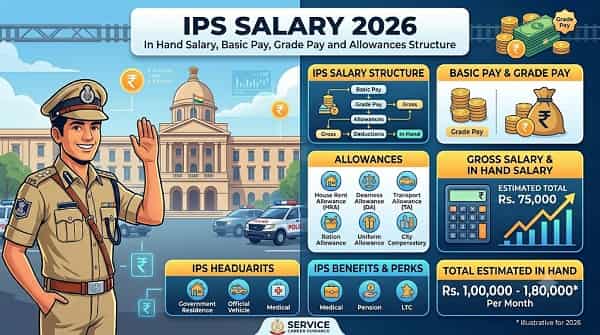
IPS Salary 2026: Quick Overview
| Component | Details |
| Starting Basic Pay | ₹56,100 (Pay Level 10) |
| Entry-Level Gross Monthly | ₹95,000 – ₹1,05,000 |
| Entry-Level In-Hand | ₹70,000 – ₹89,000 |
| Highest Basic Pay (DGP) | ₹2,25,000 |
| Training Stipend (SVPNPA) | ₹40,000 – ₹45,000 per month |
| Pay Scale Governed By | 7th Central Pay Commission |
Legal Framework: How IPS Salary Is Determined
IPS officers are recruited through the UPSC Civil Services Examination and are governed by the All India Services Act, 1951. Their salary structure follows the 7th Central Pay Commission pay matrix — the same framework used for IAS and IFS officers. The basic pay, allowances, and increments are identical to IAS at every corresponding pay level, making IPS one of the highest-paying government services in the country.
IPS Basic Pay Structure: Rank-Wise 2026
| Rank | Pay Level | Basic Pay Per Month |
| DSP / ASP (Junior Scale) | Level 10 | ₹56,100 – ₹1,77,500 |
| Superintendent of Police (SP) | Level 12 | ₹78,800 – ₹2,09,200 |
| Deputy Inspector General (DIG) | Level 13 | ₹1,23,100 – ₹2,15,900 |
| Inspector General (IG) | Level 14 | ₹1,44,200 – ₹2,18,200 |
| Additional DGP (ADGP) | Level 15 | ₹1,82,200 – ₹2,24,100 |
| Director General of Police (DGP) | Level 17 | ₹2,25,000 (Fixed) |
Annual increment of 3 percent is applied to basic pay each year. The combination of annual increments and DA revisions every 6 months ensures consistent salary growth even without promotions.
IPS Salary Components and Allowances
Basic Pay
₹56,100 at the entry level for a fresh DSP/ASP. This is the anchor for all percentage-based allowances and increases by 3 percent each year.
Dearness Allowance (DA)
Revised twice yearly — January and July — based on the All India Consumer Price Index. As of 2026, DA stands at approximately 50 percent of basic pay. For an entry-level officer, this adds approximately ₹28,050 per month. Over a 30-year career, cumulative DA revisions dramatically expand real income.
House Rent Allowance (HRA)
Varies by city of posting:
| City Category | HRA Rate |
| X Category (Metro) | 27% of Basic Pay |
| Y Category (Large Cities) | 18% of Basic Pay |
| Z Category (Other) | 9% of Basic Pay |
Most IPS officers at district and state headquarters levels receive government accommodation (an official bungalow or police quarters) instead of HRA in cash. The rental equivalent of a senior officer’s government residence in a state capital can be ₹30,000 to ₹80,000 per month — far exceeding what the cash HRA would have been.
Transport Allowance (TA)
Covers official travel expenses. Senior officers posted with official vehicles do not additionally claim TA.
Medical Benefits
Comprehensive healthcare coverage under CGHS for the officer and entire family. Free treatment at government hospitals and CGHS empanelled facilities across the country.
Dearness Allowance on Training (SVPNPA Period)
During the training period at Sardar Vallabhbhai Patel National Police Academy (SVPNPA) in Hyderabad — approximately 21 months — IPS probationers receive a stipend of ₹40,000 to ₹45,000 per month. Full pay and allowances begin after training completion and first posting.
Uniform/Kit Allowance
IPS officers receive an annual dress/uniform allowance of approximately ₹20,000 for the purchase and maintenance of official uniforms.
Risk Allowance
Additional allowance for officers posted in high-risk areas, anti-naxal operations, anti-terrorist duties, or border zones.
IPS In-Hand Salary 2026: Complete Monthly Breakdown
Entry Level (DSP/ASP — Pay Level 10)
| Component | Amount (Approx.) |
| Basic Pay | ₹56,100 |
| Dearness Allowance (50%) | ₹28,050 |
| HRA (27% — Metro) | ₹15,147 |
| Transport Allowance | ₹3,600 – ₹7,200 |
| Other Allowances | ₹2,000 – ₹3,000 |
| Gross Monthly Salary | ₹95,000 – ₹1,05,000 |
| Deduction | Amount (Approx.) |
| NPS (10% of Basic) | ₹5,610 |
| Income Tax | ₹8,000 – ₹15,000 |
| CGHS Contribution | ₹250 |
| Other Deductions | ₹500 |
| Total Deductions | ₹14,360 – ₹21,360 |
| In-Hand Salary | ₹70,000 – ₹89,000 |
The range reflects the difference between a small-city posting (lower HRA) and a metro posting (maximum HRA at 27 percent).
IPS Salary After 5, 10 and 20 Years
| Stage | Basic Pay (Approx.) | Estimated Monthly In-Hand |
| Training (SVPNPA) | ₹56,100 | ₹40,000 – ₹45,000 (stipend) |
| At First Posting (DSP/ASP) | ₹56,100 | ₹70,000 – ₹89,000 |
| After 5 years (SP level) | ₹78,800 | ₹1,00,000 – ₹1,20,000 |
| After 10 years (DIG level) | ₹1,23,100 | ₹1,40,000 – ₹1,70,000 |
| After 18–20 years (IG level) | ₹1,44,200 | ₹1,60,000 – ₹2,00,000 |
| DGP level (30+ years) | ₹2,25,000 | ₹2,50,000 – ₹3,00,000+ |
IPS Rank-Wise Career Progression
| Rank | Pay Level | Typical Service Years |
| DSP / ASP | 10 | At induction |
| SP (Superintendent of Police) | 12 | 4 – 6 years |
| DIG (Deputy Inspector General) | 13 | 13 – 15 years |
| IG (Inspector General) | 14 | 18 – 20 years |
| ADGP (Additional DGP) | 15 | 25 – 27 years |
| DGP (Director General of Police) | 17 | 30+ years |
Promotion timelines are time-based for the initial levels and become competitive at DIG and above, depending on the officer’s cadre allocation, state vacancies, and performance.
Non-Monetary Perks: The Real Value of the IPS Package
The cash salary of an IPS officer, while strong, significantly understates the real compensation package. The non-monetary components are genuinely valuable:
Government Accommodation — An official bungalow or police quarters at every posting, maintained at government expense. Senior officers typically occupy large, well-staffed official residences in prime city locations. The rental value in a state capital can be ₹50,000 to ₹1,50,000 per month or more.
Official Vehicle — A car with driver for official and personal use. At senior ranks, the vehicle fleet includes security escort vehicles as well.
Security Personnel — A personal protection team based on threat assessment. Senior officers in conflict-prone areas or high-risk postings receive permanent armed personal security.
Domestic Staff — Orderlies, cooks, and other household support at official residences, borne entirely by the government.
Central Deputation Allowance — IPS officers posted to central assignments (IB, CBI, NSG, CRPF, etc.) receive a Central Deputation Inductee (CDI) allowance of 5 percent to 10 percent of basic pay over and above their state salary.
Children’s Education Allowance — ₹2,250 per child per month for up to two school-going children.
Leave Travel Concession (LTC) — Travel reimbursement for the officer and family during leave.
Post-Retirement Pension — Officers under NPS (post-2004 recruitment) receive monthly pension based on accumulated corpus. Pre-2004 officers receive defined pension.
IPS vs IAS: Salary and Perks Comparison
Both services follow identical pay matrices under the 7th Pay Commission at every corresponding pay level. The basic pay, DA, HRA, and increment structure are the same.
| Feature | IPS | IAS |
| Starting Basic Pay | ₹56,100 | ₹56,100 |
| Peak Basic Pay | ₹2,25,000 (DGP) | ₹2,50,000 (Cabinet Secretary) |
| Government Vehicle | Yes | Yes |
| Official Residence | Yes | Yes |
| Security Detail | Yes (at most postings) | Not standard |
| Risk Allowance | Yes | No |
| Central Deputation Allowance | Yes | Yes |
The IPS officer’s peak salary is ₹2,25,000 versus the IAS Cabinet Secretary’s ₹2,50,000. The practical distinction is the nature of postings — IPS officers frequently serve in operational security environments, while IAS officers handle administrative and policy roles.
8th Pay Commission: Expected Impact on IPS Salary
The 8th Central Pay Commission, constituted in January 2025, is expected to submit recommendations for implementation from January 2026. Based on the anticipated fitment factor of approximately 2.225 to 2.5:
- Entry-level basic pay could rise from ₹56,100 to approximately ₹1,07,700 to ₹1,25,000
- All DA-linked allowances would reset to zero and begin accruing on the revised base
- Revised salaries are expected to be paid with arrears from the implementation date
Until official notification, current 7th CPC rates remain in effect.
Conclusion
IPS salary in 2026 offers one of the most comprehensive career compensation packages in Indian government service. Starting basic pay of ₹56,100, an entry-level in-hand salary of ₹70,000 to ₹89,000, and a peak DGP salary of ₹2,25,000 — combined with government accommodation, official vehicles, security personnel, lifetime medical coverage, LTC, and a structured pension — make the IPS one of the most financially secure and personally rewarding careers in the country. For aspirants driven by the opportunity to serve at the highest levels of India’s law enforcement architecture, the financial package is a fitting complement to the authority and responsibility the role carries.
FAQs
Q: What is the IPS officer’s starting salary in 2026?
A: The starting basic pay is ₹56,100 per month at Pay Level 10. Including DA, HRA, and Transport Allowance, the gross monthly salary is approximately ₹95,000 to ₹1,05,000. After NPS, tax, and other deductions, the in-hand salary ranges from ₹70,000 to ₹89,000 per month.
Q: What is the salary of an IPS officer during SVPNPA training?
A: During the approximately 21-month probationary training at the Sardar Vallabhbhai Patel National Police Academy in Hyderabad, IPS probationers receive a stipend of approximately ₹40,000 to ₹45,000 per month.
Q: What is the highest salary an IPS officer can earn?
A: The Director General of Police (DGP) at Pay Level 17 draws a fixed basic pay of ₹2,25,000 per month. With DA and all allowances, total monthly compensation at DGP level can exceed ₹3,00,000.
Q: Do IPS officers get pension after retirement?
A: Officers recruited after 2004 are under the National Pension System (NPS), with both the employee and government contributing 10 percent of basic pay monthly, building a retirement corpus. Officers recruited before 2004 receive defined pension. The Unified Pension Scheme (UPS), introduced from 1 April 2025, is available as an optional alternative for NPS subscribers.
Q: What is the difference between IPS and IAS salary?
A: Both services follow identical pay matrices and basic pay at every corresponding level. The IPS peak (DGP at ₹2,25,000) is slightly lower than the IAS peak (Cabinet Secretary at ₹2,50,000). IPS officers typically receive additional risk allowances and standard security personnel perks that differ from IAS officers.
 Saurav Mehra