 By Chetan Singh
 Home Guards are the quiet backbone of public safety in India. Every election, every major festival, every disaster response and VIP movement in any Indian city involves Home Guards working alongside the regular police force. They manage traffic, guard public property, assist at courts and jails, and step in during emergencies — often in conditions as demanding as those faced by permanent police personnel.
Their financial reality, however, is a different story from what most people assume. This article explains exactly what a Home Guard earns in India in 2026 — state by state, daily rate by daily rate, with allowances, in-hand amounts, and everything that affects their actual monthly income.
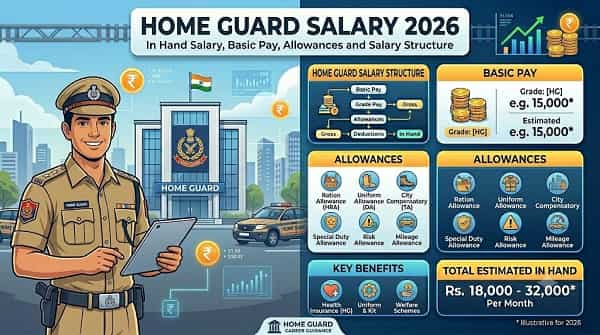
What Is a Home Guard? The Critical Context
Before the salary numbers, this distinction matters: a Home Guard is not a permanent government employee in most Indian states. They are trained auxiliary volunteers enrolled under the Home Guards Act, 1962, and deployed by state governments as per operational need. Their income is tied to duty days, not a fixed monthly salary.
A few states — notably Uttar Pradesh under its recent recruitment structure — have created more formalised Home Guard positions with structured pay scales. But across most of India, the monthly income of a Home Guard depends on how many days they are actually deployed for duty in that month.
How Home Guard Salary Is Calculated
The salary formula for most states:
Monthly Income = Daily Duty Rate × Number of Duty Days in the Month
This means:
- A Home Guard assigned 25 duty days at ₹600/day earns ₹15,000 that month
- A Home Guard assigned only 15 days earns ₹9,000
- If no duty is assigned, income is zero
Duty assignments are controlled by the District Superintendent of Police or District Commandant (Home Guards). Regular deployment is not guaranteed for all enrolled Home Guards simultaneously.
Home Guard Daily Wage and Monthly Salary: State-Wise 2026
| State | Daily Wage (Approx.) | Monthly Income (25–30 Days) |
| Delhi | ₹700 – ₹800 | ₹18,000 – ₹25,000 |
| Jharkhand | ₹1,088 (post court revision) | ₹27,000 – ₹32,640 |
| Maharashtra | ₹500 – ₹650 | ₹13,000 – ₹20,000 |
| Uttar Pradesh | ₹500 – ₹600 | ₹13,000 – ₹18,000 |
| Bihar | ₹400 – ₹500 | ₹10,000 – ₹15,000 |
| Rajasthan | ₹450 – ₹550 | ₹12,000 – ₹17,000 |
| Madhya Pradesh | ₹450 – ₹550 | ₹12,000 – ₹16,500 |
| Gujarat | ₹500 – ₹600 | ₹13,000 – ₹18,000 |
| Punjab | ₹550 – ₹650 | ₹14,000 – ₹19,500 |
| Himachal Pradesh | ₹500 – ₹600 | ₹13,000 – ₹18,000 |
Delhi consistently offers the highest daily wages among Indian states due to better government funding and high-frequency deployment requirements — traffic management, VIP security, court duties, and public events keep Delhi Home Guards among the most regularly deployed in the country.
Jharkhand stands out for a different reason — a court-revised daily wage of ₹1,088 makes it one of the highest per-day rates in the country, though duty day consistency varies.
UP Home Guard Salary 2026: A Special Case
Uttar Pradesh has emerged as a significant exception to the daily-wage model. With the UPPRPB’s 2026 recruitment of 41,424 Home Guard posts, UP has moved toward a more structured pay system under the 7th Pay Commission framework — Pay Level 3 with a Grade Pay of ₹2,000.
| Component | Amount |
| Basic Pay | ₹20,200 |
| Dearness Allowance (DA) | ₹10,000 – ₹12,000 |
| House Rent Allowance (HRA) | ₹2,000 – ₹3,000 |
| Travel Allowance (TA) | ₹900 – ₹1,200 |
| Medical Allowance | ₹500 |
| Risk Allowance | Variable |
| Gross Monthly Salary | ₹30,000 (approx.) |
| In-Hand Salary | ₹27,000 (approx.) |
The UP formalised recruitment model is closer to a regular government job than the traditional Home Guard engagement. Selected candidates receive structured pay, DA, HRA, and retirement benefits — making it significantly more attractive than the daily-wage model in other states.
Allowances and Benefits for Home Guards
The actual allowances available depend entirely on the state and whether the Home Guard is under a formalised pay structure or a daily-duty model.
For Formalised Roles (UP and similar states):
- Dearness Allowance (DA) — revised periodically
- House Rent Allowance (HRA)
- Travel Allowance (TA)
- Medical Allowance
- Risk and Hardship Allowance for high-risk postings
- Uniform Allowance — kit and uniform provided or reimbursed
- Retirement / pension benefits in some states
For Daily-Duty Model (Most States):
- Uniform kit provided on joining
- Travel/DA allowance when deployed outside home district for election or emergency duty
- Night duty supplement in some states for nocturnal assignments
- Ration allowance in specific postings
What Home Guards Generally Do NOT Receive:
- Pension (in most states under the volunteer/daily-wage model)
- Provident Fund contributions
- Gratuity
- Medical coverage comparable to regular police
High-Duty Situations That Boost Monthly Income
Home Guard income is not static. Certain deployment scenarios bring higher duty allocation and sometimes enhanced daily rates:
Election Duty — District and state elections require massive Home Guard deployment for polling station security, crowd management, and EVM protection. This can mean 20 to 30 continuous duty days in election months with additional election duty allowances on top.
Disaster Management — Floods, cyclones, and industrial accidents trigger emergency deployment with potential additional compensation.
VIP Security — Deployment for dignitaries, rallies, and state functions often carries supplementary allowances.
Night Duty — Multiple states pay a higher daily rate or a separate night duty supplement for overnight assignments.
In high-duty months combining regular assignments and special deployments, a Home Guard in Delhi or UP can see monthly income reach ₹20,000 to ₹25,000 or more.
Home Guard Salary vs Police Constable Salary
A clear comparison helps aspirants make informed decisions:
| Feature | Home Guard | Police Constable |
| Nature of Job | Auxiliary / Volunteer (most states) | Permanent Government Employee |
| Monthly Pay | ₹10,000 – ₹25,000 (duty-dependent) | ₹25,000 – ₹40,000 (fixed) |
| DA / HRA | Not applicable (most states) | Applicable |
| Pension | Not available (most states) | Available |
| Job Security | No fixed tenure | Permanent |
| Medical Benefits | Limited | Full CGHS equivalent |
The Home Guard role, however, is frequently used as a stepping stone — experience, fitness record, and familiarity with law enforcement operations give Home Guards an advantage in police constable and related recruitment processes in several states.
Career Growth and Future Prospects
Traditional Home Guard roles offer limited internal promotions. The hierarchy within the Home Guard force includes positions like Section Commander, Platoon Commander, and Company Commander, but movement into these roles is based on seniority and performance over many years of service.
More practically, many Home Guards leverage their experience for:
- Preference in state police constable recruitment
- Application to CAPF (BSF, CRPF, CISF) positions
- Security guard and supervisory roles in the private sector
- State-specific reservation quotas for ex-Home Guards in government jobs
Conclusion
Home Guard salary in India in 2026 ranges from approximately ₹10,000 to ₹25,000 per month for most states under the daily-duty model, and up to ₹27,000 in-hand per month in formalised recruitment states like Uttar Pradesh. The income is not fixed — it depends on duty days, state government policy, deployment frequency, and the nature of assignments. For those seeking a first step into public safety and law enforcement, the Home Guard role offers practical field experience, a degree of financial stability, and genuine community service value — even if it falls well short of a permanent government job in terms of total compensation.
FAQs
Q: What is the monthly salary of a Home Guard in India in 2026?
A: It varies by state and duty days. Under the daily-wage model, monthly income typically ranges from ₹10,000 to ₹25,000. In formalised pay structures like UP’s 7th CPC-based recruitment, in-hand salary reaches approximately ₹27,000 per month.
Q: Do Home Guards receive pension in India?
A: No, in most Indian states Home Guards do not receive pension benefits. They are enrolled as auxiliary volunteers, not permanent government employees. Some states with formalised recruitment structures may offer limited retirement benefits.
Q: Which state pays Home Guards the most in India?
A: Delhi offers one of the highest daily rates at ₹700 to ₹800 per day. Jharkhand, after a court-revised daily wage of ₹1,088, also provides among the highest per-day rates. For structured monthly pay, UP’s formalised Home Guard posts offer approximately ₹27,000 in hand per month.
Q: Can a Home Guard become a permanent police officer?
A: Not directly. However, Home Guard experience is valued during police constable recruitment in several states, and some states offer reserved quotas or preference to ex-Home Guards in law enforcement recruitment.
Q: Does the 7th Pay Commission apply to Home Guards?
A: In most states, no — Home Guards are paid daily wages outside the CPC pay matrix. However, Uttar Pradesh has adopted a 7th CPC-based structure (Level 3, Grade Pay ₹2,000) for its recently recruited formalised Home Guard posts, offering DA, HRA, and structured increments.
 Saurav Mehra