 By Chetan Singh
 Every year, millions of graduates sit for the IBPS Clerk examination — officially called the Customer Service Associate (CSA) exam — making it one of the most competitive entry-level banking recruitment drives in India. The attraction is straightforward: a structured salary, annual increments built into a clearly defined pay scale, a set of allowances that meaningfully boost the monthly take-home, and a career path that can eventually take a committed clerk all the way to managerial level.
This article covers the complete IBPS Clerk salary structure for 2026 — basic pay, all allowances, deductions, in-hand figures, and how the salary grows across the career.
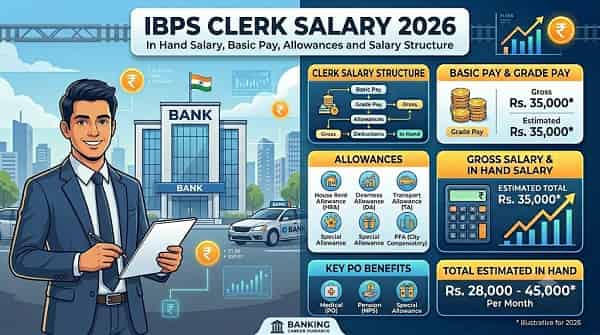
IBPS Clerk Salary 2026: Quick Overview
| Component | Details |
| Starting Basic Pay (Base) | ₹24,050 |
| Starting Basic Pay (Graduate with 2 advance increments) | ₹26,730 |
| Gross Monthly Salary | ₹40,720 – ₹46,890 |
| In-Hand Salary Per Month | ₹37,734 – ₹43,000 |
| Maximum Basic Pay (20 years) | ₹64,480 |
| Pay Scale Revised Under | 12th Bipartite Settlement |
The 12th Bipartite Settlement revised the starting basic pay from ₹19,900 to ₹24,050 — a hike of approximately 17 percent — making this the most significant salary revision for the clerical banking cadre in recent years. Graduate candidates receive two advance increments at joining, making the effective starting basic pay ₹26,730.
IBPS Clerk Pay Scale 2026
The official IBPS Clerk pay scale under the 12th Bipartite Settlement is:
₹24,050 – 1,340/3 – 28,070 – 1,650/3 – 33,020 – 2,000/4 – 41,020 – 2,340/7 – 57,400 – 4,400/1 – 61,800 – 2,680/1 – 64,480 (20 Years)
This structured increment system means:
- Annual increment of ₹1,340 for the first 3 years after base
- ₹1,650 for the following 3 years
- ₹2,000 for the next 4 years
- ₹2,340 for 7 years after that
- ₹4,400 in year 18, then ₹2,680 twice more
Since allowances like DA and HRA are calculated as percentages of basic pay, every annual increment proportionally increases the total gross and in-hand salary — not just the base.
IBPS Clerk Salary Structure: All Components
Basic Pay
The foundation. For a fresh graduate joining in 2026, effective starting basic pay is ₹26,730 after two advance increments.
Dearness Allowance (DA)
Revised quarterly based on the Consumer Price Index (CPI). As of 2026, DA rates are approximately 55 to 60 percent of basic pay. For a basic pay of ₹26,730, DA adds approximately ₹14,700 to ₹16,038 per month. This is one of the fastest-growing salary components over time — quarterly revisions mean that the total monthly salary increases even between annual increments.
House Rent Allowance (HRA)
Calculated based on the city of posting. IBPS uses population-based tiers for HRA determination:
| City Category | Population | HRA Rate |
| Major Urban Areas | Above 45 lakh | 9% of Basic Pay |
| Large Cities | 12 – 45 lakh | 7% of Basic Pay |
| Other Cities | Below 12 lakh | 5% of Basic Pay |
For a basic pay of ₹26,730, metro HRA amounts to approximately ₹2,406 per month. Clerks allotted bank quarters receive a nominal HRA in lieu of accommodation.
Special Allowance
An additional fixed monthly component introduced under bipartite settlements. This is calculated as a percentage of basic pay and adds meaningfully to the gross salary.
Transport Allowance
A fixed monthly component to support commuting costs, varying by city and posting location.
Medical Allowance
A periodic medical reimbursement facility available to employees and their families as per the bank’s staff welfare rules.
IBPS Clerk Gross Salary Breakdown (Metro City — 2026)
| Component | Amount (Approx.) |
| Basic Pay | ₹26,730 |
| Dearness Allowance (~55%) | ₹14,701 |
| Special Allowance | ₹3,000 – ₹4,000 |
| HRA (9% — Major Urban) | ₹2,406 |
| Transport Allowance | ₹600 – ₹900 |
| Gross Monthly Salary | ₹40,720 – ₹46,890 |
The variance in gross salary between different sources reflects differences in DA rate applied, city category, and whether additional special allowances unique to specific banks are counted.
IBPS Clerk In-Hand Salary After Deductions
| Deduction | Amount (Approx.) |
| NPS Contribution (10% of basic) | ₹2,673 |
| Professional Tax | ₹200 |
| Union Membership Fee | ₹50 – ₹100 |
| Income Tax (if applicable) | Variable |
| Total Deductions | ₹2,986 – ₹4,000 |
| Net In-Hand Salary | ₹37,734 – ₹43,000 |
The exact in-hand figure varies by bank and posting city. Metro postings produce higher gross and in-hand amounts due to elevated HRA. The 12th Bipartite Settlement significantly improved the take-home compared to previous years — before the revision, freshers were taking home approximately ₹26,000 to ₹28,000 per month.
IBPS Clerk Salary After 5 and 10 Years
| Years of Service | Basic Pay (Approx.) | Estimated In-Hand |
| At Joining | ₹26,730 | ₹37,734 – ₹43,000 |
| After 3 years | ₹28,070 | ₹42,000 – ₹46,000 |
| After 5 years | ₹31,370 – ₹33,020 | ₹45,000 – ₹50,000 |
| After 10 years | ₹41,020+ | ₹58,000 – ₹65,000 |
| Maximum (20 years) | ₹64,480 | ₹85,000+ |
As basic pay increases through annual increments, DA and HRA rise proportionally — meaning total in-hand salary growth is faster than the increment amount alone suggests. The 13th Bipartite Settlement, when it arrives in the coming years, will deliver another round of revision that candidates joining in 2026 will benefit from mid-career.
Additional Perks and Benefits
Beyond the monthly salary, IBPS Clerk employees receive a set of benefits that add significant long-term value:
National Pension System (NPS) — The bank contributes a matching 10 percent of basic pay toward the employee’s retirement corpus, building substantial post-retirement savings alongside the employee’s own contribution.
Concessional Loans — One of the most practically valuable perks. IBPS Clerks are eligible for home loans, car loans, and personal loans at significantly subsidised interest rates. On a ₹40 lakh home loan over 20 years, the interest saving compared to market rates can easily amount to ₹10 to ₹15 lakh or more.
Leave Travel Concession (LTC) — Travel reimbursement for the employee and family during annual leave.
Medical Benefits — Health coverage for the employee and dependents under the bank’s staff medical scheme.
Newspaper and Other Allowances — Minor periodic reimbursements specific to individual bank policies.
Festival Allowances — Some banks provide a one-time festival bonus or allowance annually.
Staff Quarters — Bank accommodation may be available at select postings in lieu of HRA.
IBPS Clerk Training Period and Salary
Selected candidates undergo a 6-month training period, which may be extended based on performance. During training, candidates receive a stipend equivalent to the starting basic pay of ₹24,050 per month. Full allowances including HRA become applicable after permanent posting following confirmation.
Promotion Path: From Clerk to Officer
The IBPS Clerk promotion ladder is clearly defined and accessible through internal examinations:
| Stage | Route |
| Clerk to Junior Management Grade Scale-I | Internal written exam after 2 years of service |
| JMGS-I to MMGS-II (Middle Manager) | Internal exam + performance |
| MMGS-II to MMGS-III (Senior Manager) | Internal exam + seniority |
| Senior Manager to Chief Manager | Performance + merit |
| Chief Manager to AGM, DGM, GM | Merit-based progression |
Upon promotion to JMGS-I officer, the entire salary structure shifts to the officer pay scale — bringing a significant jump in basic pay, allowances, and total monthly compensation.
IBPS Clerk vs SBI Clerk: Key Salary Difference
Both roles have identical pay scales under the same bipartite settlement. The primary difference is that SBI Clerk (Junior Associate) graduates receive two advance increments at joining — the same as IBPS Clerk. Allowances, HRA tiers, and increment structures are similarly structured. SBI has historically offered slightly better leased accommodation and staff welfare benefits at senior postings due to the bank’s scale, but the base salary structure is uniform across public sector banks.
Conclusion
IBPS Clerk salary in 2026 is one of the most competitive entry-level packages among public sector government jobs, especially after the 12th Bipartite Settlement raised the starting basic pay to ₹24,050 (₹26,730 for graduates). The monthly in-hand salary of ₹37,734 to ₹43,000 is supported by quarterly DA revisions, annual increments, concessional loan benefits, NPS matching contributions, and a well-structured promotion ladder. For graduates seeking a stable, respectable government banking career with clear long-term financial growth and early promotion opportunities, the IBPS Clerk post remains one of the most rewarding choices in India.
FAQs
Q: What is the IBPS Clerk in-hand salary in 2026?
A: After standard deductions including NPS, professional tax, and minor contributions, the net in-hand salary for a freshly joined IBPS Clerk ranges from approximately ₹37,734 to ₹43,000 per month, depending on the posting city and applicable HRA.
Q: What is the starting basic pay for IBPS Clerk after the 12th Bipartite Settlement?
A: The base starting pay is ₹24,050 per month. Graduate candidates receive two advance increments, making the effective starting basic pay ₹26,730 — an improvement from the pre-settlement figure of ₹19,900.
Q: What is the maximum salary an IBPS Clerk can earn?
A: The maximum basic pay in the IBPS Clerk pay scale is ₹64,480 after approximately 20 years of service. With DA and allowances at that stage, total monthly earnings comfortably exceed ₹85,000.
Q: When can an IBPS Clerk get promoted to officer?
A: After a minimum of 2 years of service, a clerk becomes eligible to appear for internal promotion examinations for Junior Management Grade Scale-I (JMGS-I). The merit channel allows faster movement while the seniority channel follows a structured timeline.
Q: Do IBPS Clerks get concessional loans?
A: Yes. IBPS Clerks are eligible for home loans, car loans, and personal loans at significantly reduced interest rates compared to market rates — one of the most financially valuable non-salary perks of the role.
 Saurav Mehra