 By Saurav Mehra
Every time you step onto a Vande Bharat, board an LHB-fitted Rajdhani, or squeeze into a crowded suburban EMU, you’re riding equipment built by one of the companies on this list of the top 10 train/railway coach manufacturers in India 2026. What used to be an almost entirely government-run manufacturing ecosystem has opened up in recent years, with private players now building complete trainsets alongside the traditional Railway-owned factories.
That shift matters. With the Vande Bharat Sleeper now running commercially and India targeting a fleet of 800 semi-high-speed trains by 2030, understanding who actually builds what has become genuinely relevant, whether you’re a rail enthusiast, an engineering student, or someone tracking India’s manufacturing story.
Manufacturers Overview
| Manufacturer | Ownership | Location | Known For |
| Integral Coach Factory (ICF) | Government (Indian Railways) | Chennai, Tamil Nadu | World’s largest rail coach manufacturer, Vande Bharat pioneer |
| Rail Coach Factory (RCF) | Government (Indian Railways) | Kapurthala, Punjab | LHB coaches, Tejas high-speed coaches |
| Modern Coach Factory (MCF) | Government (Indian Railways) | Rae Bareli, Uttar Pradesh | Automated mass production |
| BEML Limited | Government (Defence PSU) | Bengaluru, Karnataka | Metro coaches, Vande Bharat Sleeper (initial batch) |
| Titagarh Rail Systems | Private | Kolkata, West Bengal | Metro coaches, wagons, Vande Bharat Sleeper (future batch) |
| BHEL | Government | Multiple locations | Propulsion systems, Vande Bharat Sleeper consortium partner |
| Alstom India | Private (French MNC) | Sri City, Andhra Pradesh | Metro rolling stock, high-speed technology |
| Medha Servo Drives | Private | Hyderabad, Telangana | Propulsion and control systems |
| Texmaco Rail & Engineering | Private | Kolkata, West Bengal | Freight wagons, specialized rolling stock |
| Jupiter Wagons | Private | Kolkata, West Bengal | Wagons, rolling stock components |
1. Integral Coach Factory (ICF), Chennai
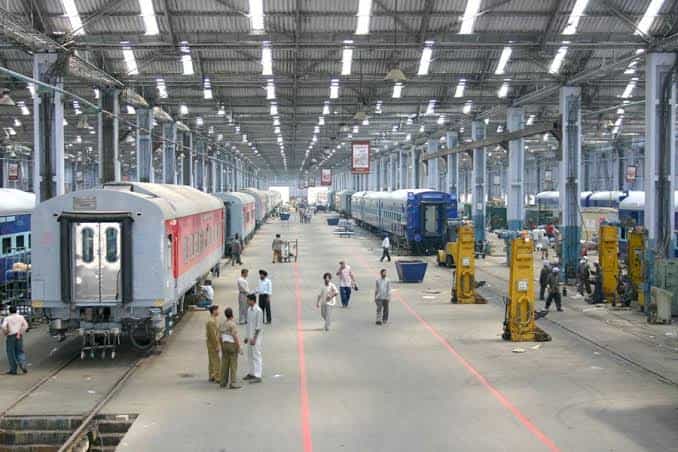
ICF isn’t just India’s oldest coach factory — it holds the title of the world’s largest rail coach manufacturer, a claim backed by genuinely staggering production numbers. Established in 1955 in Perambur, Chennai, ICF has built over 54,000 coaches historically and continues rolling out thousands annually.
- Manufactured 3,007 coaches in a single recent fiscal year, surpassing its own previous records
- Pioneered and continues producing the semi-high-speed Vande Bharat trainsets
- Products have been exported to countries including Sri Lanka, Bangladesh, Tanzania, and Mozambique
ICF’s evolution from producing traditional coaches to building India’s flagship modern trainsets says a lot about how far domestic rail manufacturing has come.
2. Rail Coach Factory (RCF), Kapurthala
RCF has quietly built more than 41,000 coaches since its founding in 1986, accounting for over half of all coach production across Indian Railways historically. It specializes particularly in LHB coaches, the safer, more stable design that’s gradually replaced older ICF-style coaches across the network.
RCF also holds the distinction of being the sole manufacturer of the Tejas high-speed coach, giving it a specialized niche within the broader coach-manufacturing landscape.
3. Modern Coach Factory (MCF), Rae Bareli
MCF represents the newest generation of Railway-owned manufacturing, built with a deliberate focus on automation and scaled mass production. As demand for coaches keeps climbing alongside India’s expanding passenger network, MCF’s automated processes have become essential to meeting production targets without proportionally increasing labor requirements.
Between the three government factories — ICF, RCF, and MCF — India’s total annual coach production has grown substantially, moving well past the roughly 3,300-coach average seen just over a decade ago.
4. BEML Limited
BEML, headquartered in Bengaluru and primarily known as a defence public sector undertaking, has built a serious presence in metro coach manufacturing alongside its heavier industrial equipment business. Notably, BEML manufactured the first operational Vande Bharat Sleeper trainset, which entered commercial service on the Howrah-Kamakhya route in January 2026.
- Deep experience in metro rolling stock for multiple Indian cities
- Strong defence-sector manufacturing background feeding into rail engineering standards
- Continues to play a role in early-stage sleeper trainset production alongside newer private entrants
5. Titagarh Rail Systems
Titagarh holds a genuinely historic position — it was the first private company in India to manufacture trains for Indian Railways, starting back in 2007. That early entry has paid off significantly: the company, alongside BHEL, won a roughly ₹24,000-crore contract to design and manufacture 80 Vande Bharat Sleeper trainsets, including 35 years of maintenance.
Its Uttarpara facility in Kolkata is currently the only plant in India capable of manufacturing both stainless steel and aluminium coaches under one roof, with capacity plans expanding from 300 to 850 coaches annually. Beyond passenger trains, Titagarh also builds metro coaches for cities including Bengaluru and Ahmedabad, alongside a massive wagon manufacturing operation.
6. Bharat Heavy Electricals Limited (BHEL)
BHEL’s role in rail manufacturing centers on propulsion systems and electrical equipment rather than complete coach bodies, but its partnership with Titagarh on the Vande Bharat Sleeper project puts it squarely among the sector’s key players. As a state-owned engineering giant with decades of experience across power generation and industrial equipment, BHEL brings serious technical depth to the propulsion side of India’s rail modernization push.
7. Alstom India
Alstom operates as a genuinely major private-sector player, particularly in metro rolling stock, with its Sri City facility in Andhra Pradesh serving as a key manufacturing hub. The French multinational has competed directly for large Vande Bharat contracts and continues supplying rolling stock and signaling technology across multiple Indian metro systems.
Its global engineering background gives it access to high-speed rail technology that domestic-only manufacturers are still catching up on, making it a name worth watching as India pushes toward higher-speed corridors.
8. Medha Servo Drives
Medha, based in Hyderabad, focuses specifically on propulsion and control systems rather than complete coach manufacturing. It’s participated in consortium bids alongside international partners like Stadler Rail for major rolling stock contracts, positioning itself as a specialized technology supplier feeding into the broader coach ecosystem rather than a standalone train builder.
9. Texmaco Rail & Engineering
Texmaco has built its reputation primarily around freight wagon manufacturing, an often-overlooked but genuinely critical part of India’s rail infrastructure. Based in Kolkata, the company supplies specialized rolling stock for cargo and industrial transport, complementing the passenger-focused manufacturers that dominate public attention.
10. Jupiter Wagons
Jupiter Wagons rounds out this list as another Kolkata-based private player focused on wagons and rolling stock components. As India’s freight corridor projects expand and demand for modern, efficient wagons grows, companies like Jupiter play an essential supporting role that rarely makes headlines but keeps the broader rail ecosystem functioning.
Understanding the Shift Toward Private Manufacturing
A few practical points help make sense of how this sector is actually evolving:
- Government factories still dominate overall volume — ICF, RCF, and MCF collectively produce the vast majority of coaches running on Indian Railways today
- Private players are winning increasingly large, complex contracts — the Titagarh-BHEL Vande Bharat Sleeper deal marks the first time a private consortium secured a complete design-manufacture-maintain contract at this scale
- Consortium models are becoming standard for advanced trainsets — pairing a rolling-stock specialist with a propulsion or electrical partner (like Titagarh-BHEL or Medha-Stadler) is now the norm for major bids
- Export potential is growing alongside domestic capacity — ICF coaches already run in several countries, and Vande Bharat technology is being positioned for future export markets
- Kavach and safety systems are now central to new contracts — modern trainsets increasingly bundle India’s indigenous automatic train protection technology as a standard feature, not an add-on
FAQs
Q1. What’s the actual difference between ICF coaches and LHB coaches?
LHB coaches, mainly built by RCF, feature a more stable, anti-climbing design that reduces derailment risk and improves ride comfort compared to older ICF-style coaches. Indian Railways has been steadily phasing out older ICF coaches in favor of LHB and newer designs.
Q2. Are private companies like Titagarh actually replacing government coach factories?
No, private manufacturers are supplementing rather than replacing ICF, RCF, and MCF, which still produce the bulk of India’s coaches. Private players are increasingly winning specialized, large-scale contracts like the Vande Bharat Sleeper project rather than taking over routine coach production.
Q3. Is the Vande Bharat Sleeper train currently running, or still in testing?
The first Vande Bharat Sleeper train became commercially operational in January 2026 on the Howrah-Kamakhya route, after completing trial runs and safety certification. Additional sleeper trainsets from the Titagarh-BHEL consortium are still in production for future rollout.
Q4. Do any of these companies offer engineering jobs or apprenticeships for students in India?
Yes, government factories like ICF, RCF, and MCF regularly recruit through Railway Recruitment Board exams and apprenticeship programs. Private manufacturers like Titagarh and Alstom also hire engineering graduates directly, particularly for their expanding rolling stock and propulsion divisions.